

Most of us do not think about carbon monoxide or gas leaks until something goes wrong. No doubt, that is the unsettling truth. Both threats are invisible, odorless in the case of CO, and fast-moving. By the time anyone notices, the situation can already be life-threatening.
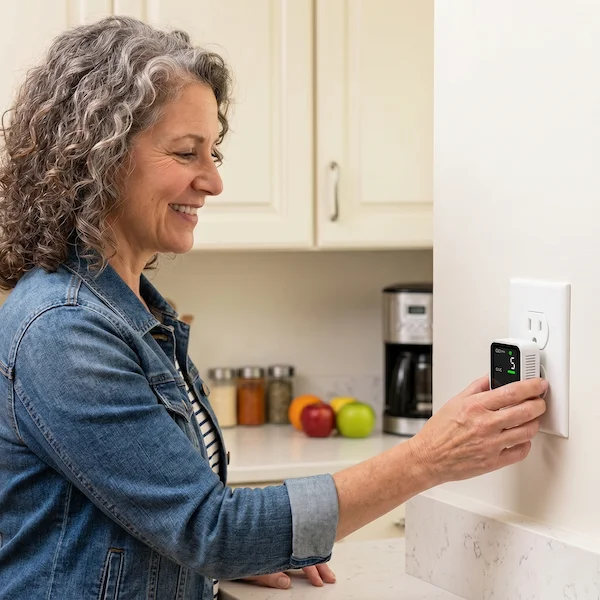
I came across the PreparedHero Dual Threat Detector while looking for something practical to set up at my mother’s house. She lives alone, uses a gas stove, and has an older furnace in the basement. Like most parents, she insisted she was fine. Like most children watching from a distance, I was not so sure.
What drew me to this device was not the marketing. It was the idea of one plug doing two jobs simultaneously. Most detectors on the market cover either carbon monoxide or combustible gas — rarely both in a single unit at this price point.
That distinction matters, especially in older homes where both risks tend to coexist.
The device plugs directly into a wall outlet. There is no drilling, no electrician, no complicated setup. That simplicity was, frankly, the first thing I appreciated. My mother was not going to follow a twelve-step installation guide, and I was not going to be there every week to maintain it.
Beyond the convenience factor, this review takes a closer look at how the device actually works, what it detects and how, who genuinely needs it, and where it falls short. Because no product is perfect — and anyone making a safety decision deserves a straight answer, not just another sales pitch.
If you are here to decide whether this detector is worth buying, that is exactly what this article covers.
What Is the PreparedHero Dual Threat Detector?

The PreparedHero Dual Threat Detector is a plug-in home safety device that monitors two separate hazards at once: carbon monoxide and combustible gases, including natural gas, propane, and methane. Unlike traditional standalone detectors that focus on only one of these threats, this unit handles both through a single wall outlet.
At its core, the device uses two different sensors working in parallel. One targets CO, the other targets combustible gas. Each sensor operates independently, so detecting one threat does not interfere with the other. The results from both sensors appear in real time on a digital display built into the front of the unit.
That display is worth noting. Instead of a simple color-coded light that leaves you guessing, the screen shows actual readings — CO levels in parts per million (PPM) and gas levels as a percentage of the Lower Explosive Limit (LEL). You can glance at it and know exactly what is in the air, not just whether an alarm has triggered.
The design itself is compact and unobtrusive. It plugs flush into a standard outlet without requiring a second slot or an adapter in most cases. Setup takes under a minute. There are no batteries to manage, no app to configure, and no account to create. You plug it in, and it starts monitoring.
Basically, the PreparedHero brand sits under a broader company that has reportedly served over 2.5 million customers across its product range. The Dual Threat Detector is one of their more focused safety offerings, and it is positioned specifically for households where simplicity and reliability matter more than advanced smart-home features.
On the official website, it comes with a one-year warranty and a 30-day return window. Pricing varies by pack size, with single units available and multi-pack options at a lower per-unit cost. At the time of writing, it is sold directly through the brand’s website with promotional pricing that is not available on third-party retailers like Amazon.
In short, it is not a high-tech gadget. It is a practical, low-friction safety device built around a clear purpose: catch two of the most common silent household hazards before they become emergencies.
Does the PreparedHero Dual Threat Detector Work? The Science Behind It
Understanding whether this device actually works means understanding the two separate technologies inside it. Each sensor is designed for a fundamentally different type of threat, and they operate on completely different scientific principles.
Detecting Carbon Monoxide: The Electrochemical Sensor
Carbon monoxide detection in this device uses an electrochemical sensor, which is the same approach used in professional-grade CO monitors. The sensor contains a small electrochemical cell with two electrodes — a working electrode and a counter electrode — separated by an electrolyte solution.
When CO molecules enter the sensor, they react at the working electrode in an oxidation reaction. This reaction transfers electrons, creating a measurable electrical current. The strength of that current is directly proportional to the concentration of CO in the surrounding air. The device reads this current and converts it into a PPM (parts per million) value, which it displays on the screen.
The sensor operates across a range of 0 to 1,000 PPM. For context, the U.S. Occupational Safety and Health Administration sets a permissible exposure limit of 50 PPM over an 8-hour workday. At 200 PPM, symptoms like headaches begin within 2 to 3 hours. At 400 PPM, the exposure becomes life-threatening within 3 hours. The PreparedHero unit is designed to alarm before levels reach dangerous thresholds, giving occupants time to ventilate and evacuate.
Electrochemical sensors are favored for CO detection because they are highly specific to CO molecules and resistant to interference from other gases. They also respond relatively quickly — typically within 60 seconds of exposure — which matters when you are dealing with a gas that incapacitates people before they realize what is happening.
Detecting Combustible Gas: The Semiconductor Sensor
The gas detection side of the device uses a semiconductor sensor, sometimes called a metal oxide semiconductor (MOS) sensor. This works on a completely different principle. The sensor contains a heated metal oxide material — typically tin dioxide — whose electrical resistance changes when combustible gas molecules make contact with its surface.
In clean air, the metal oxide has a predictable baseline resistance. When natural gas, propane, or methane molecules bond with oxygen on the surface of the heated material, they alter that resistance in a measurable way. The device reads this resistance change, interprets it as a gas concentration, and displays it as a percentage of the LEL — the Lower Explosive Limit.
The LEL is the minimum concentration of gas in air at which it can ignite. For methane (natural gas), the LEL is approximately 5% by volume in air. For propane, it sits around 2.1%. The device monitors from 0 to 100% LEL, meaning it can detect gas concentrations well before they reach levels that could ignite. Most safety standards recommend alarming at 10 to 25% LEL to provide an adequate safety margin.
Semiconductor sensors are effective at detecting a broad range of combustible gases, which is why this device can pick up natural gas, propane, and methane rather than a single specific compound. The trade-off is that they can occasionally respond to other volatile organic compounds — including cooking fumes at high concentrations — which is why placement matters.
The Real-Time Digital Display
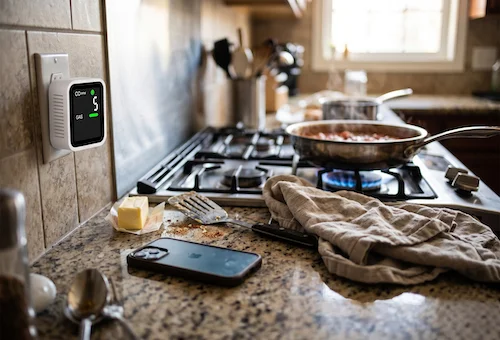
The display does more than just show numbers. It provides continuous, real-time feedback from both sensors simultaneously. This matters for a couple of reasons. First, you can check baseline levels at any time without triggering an alarm. Second, you can watch readings change during activities like cooking, which helps distinguish a normal kitchen environment from a genuine leak.
Most consumer-level detectors give you a green, yellow, or red light. This device gives you actual data. That distinction changes how you interact with the device, especially in situations where you want to confirm whether a smell near the stove is harmless combustion byproduct or something more concerning.
Together, these two sensors cover the two most common invisible gas hazards in residential settings. CO is produced by incomplete combustion from furnaces, water heaters, cars, and fireplaces. Natural gas and propane leaks come from appliances, fittings, and supply lines. In most homes, both risks exist in the same rooms — yet most detectors address only one of them.
Features of the PreparedHero Dual Threat Detector
Dual-Sensor Detection: The device contains two independent sensors — electrochemical for CO and semiconductor for combustible gas — operating simultaneously in one unit. Each handles its own threat without interference from the other.
Real-Time Digital Display. A built-in screen shows live CO readings in PPM and gas readings in % LEL. The display updates continuously, so you always have an actual reading rather than just a status light.
Audible Alarm: When either sensor detects levels above the alarm threshold, the unit emits a loud alert. This is designed to be audible across a room, including for people who may be asleep or in an adjacent space.
No Battery Required: The device draws power directly from the wall outlet. There is no battery to replace, no low-battery chirping to deal with, and no risk of the device going dark because someone forgot to swap out the AAs.
Plug-In Installation: The unit plugs into any standard household outlet. No drilling, no mounting hardware, no tools. Setup is literally plug-in-and-done, which makes it accessible for renters, older adults, and anyone who does not want to modify their home.
Wide Monitoring Range: CO detection spans 0 to 1,000 PPM; gas detection covers 0 to 100% LEL. These ranges allow the device to detect both early-stage and escalating levels of each hazard.
Compact Design: The unit is small enough to sit flush in an outlet without dominating an entire wall panel. It does not occupy additional outlet space in most standard configurations.
No App or Connectivity Required: The device works entirely on its own. It does not need Wi-Fi, Bluetooth, or a smartphone app to function. Everything it reports appears on the unit itself.
How to Use the PreparedHero Dual Threat Detector for Best Results
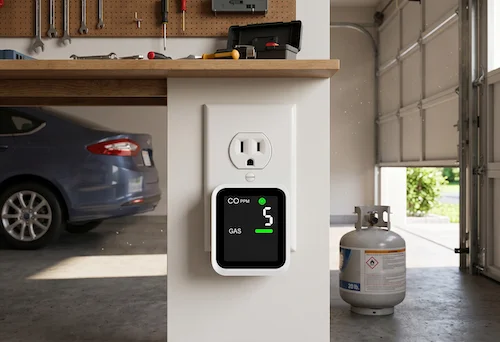
Placement makes a significant difference with this type of device. Carbon monoxide is roughly the same density as air, so it disperses evenly through a room. In contrast, natural gas and propane behave differently — methane (natural gas) rises because it is lighter than air, while propane sinks because it is heavier. For a combined detector, plugging it in at an intermediate height, roughly waist to chest level, gives the best coverage for both threats.
Install it in the rooms where the risk is highest. The kitchen is an obvious first choice, especially if you have a gas stove. The basement, where furnaces and water heaters tend to live, is another priority location. If you are setting up multiple units, start with those two rooms before moving to bedrooms or hallways.
Avoid placing it directly next to a stove or oven. Cooking combustion produces trace gases that can briefly elevate semiconductor sensor readings without any actual leak being present. Positioning the detector a few feet away — still in the kitchen, but not immediately adjacent to the burners — reduces the chance of nuisance alarms during normal cooking.
Once plugged in, let the device run through its startup cycle before treating readings as accurate. Most semiconductor sensors require a brief warm-up period of a few minutes before stabilizing. After that, no action is required — the device monitors continuously without any input from you.
Is the PreparedHero Dual Threat Detector Any Good?
Honestly, yes — within the scope of what it is designed to do. It is not a smart home device. It will not send alerts to your phone or log historical data. However, for a household that simply needs reliable dual-threat monitoring without any technical complexity, it delivers.
The combination of two proven sensor technologies in a single plug-in unit is genuinely useful. Most hardware store CO detectors do not include a gas sensor. Most gas sensors do not include CO detection. Buying two separate devices means two outlet spots, two potential battery situations, and twice the setup. This device consolidates that into one.
The real-time digital display is something I did not expect to value as much as I do. Being able to check actual readings — not just wait for an alarm — makes the device feel like a proper monitoring tool rather than a passive alert box. That transparency builds a different kind of confidence in the device.
Customer feedback across thousands of reviews reflects a consistent theme: people buy it for a parent, appreciate how easy installation is, and end up ordering more for other family members. That pattern is telling. When something is genuinely simple to use and does what it promises, that is usually the result.
Who Needs the PreparedHero Dual Threat Detector?
This device is not just for one type of household. It covers a wider range of situations than most people initially consider.
Adult children managing an elderly parent’s home are perhaps the most obvious audience. When a parent lives alone, uses gas appliances, and has aging heating equipment, the risk exposure is real and ongoing. A plug-in device that requires no upkeep is a practical safety measure that does not depend on the parent remembering to do anything.
Renters also benefit significantly. Landlords are not universally required to install wired combination detectors. A plug-in unit covers the gap immediately and moves with you when you do.
Anyone with a gas stove, gas furnace, gas water heater, or attached garage is living with CO and gas leak risk every day. That describes the majority of homes in the U.S. The device is not a niche product — it addresses universal household risks that most people have simply chosen not to think about.
Families with young children, households in older buildings with aging ventilation systems, and anyone who travels and wants to monitor a property while away all fall into the same category: people who would benefit from an always-on dual detector with no maintenance requirements.
Benefits of the PreparedHero Dual Threat Detector
Catches two invisible household hazards — carbon monoxide and combustible gas — with a single device.
Requires zero installation beyond plugging into a wall outlet, making it accessible for any age or technical ability.
Eliminates battery management entirely, which is one of the main reasons standalone detectors fail when they are needed most.
Displays real CO (PPM) and gas (% LEL) readings in real time, so you can monitor levels rather than just wait for an alarm.
Works for renters and temporary living situations since it plugs in and unplugs without any modifications to the space.
Covers natural gas, propane, and methane — not just one combustible gas type — making it suitable for a wider range of homes.
Reduces the need for two separate detectors, saving wall outlet space and simplifying home safety monitoring.
Low-friction setup means it can be installed for an elderly parent or family member during a single visit without assistance needed afterward.
Provides peace of mind in rooms where risk is highest: kitchens, basements, and garages, without any ongoing effort.
Comes with a 30-day return guarantee and one-year warranty, reducing the risk of a bad purchase experience.
Why Is the PreparedHero Dual Threat Detector Recommended?
It addresses a gap most people do not notice until it matters. Standard CO detectors are widely available, but they cover only one of two major invisible gas threats. The Dual Threat Detector fills both gaps at once. Most households carry both risks — from gas appliances and from combustion sources — yet protect against neither or only one. This device changes that with minimal friction.
The technology behind it is not gimmicky. Electrochemical CO sensing and semiconductor gas sensing are both established, tested technologies used in industrial and professional safety equipment. The device applies them in a consumer-friendly package without compromising on how the detection actually works. That is not always the case with budget safety devices.
Installation takes no time and requires no skill. For a device that is primarily bought for elderly relatives, renters, or people who simply do not want to deal with home projects, the plug-in design is a genuine differentiator. Many better-equipped detectors never get installed because the process feels overwhelming. This one avoids that entirely.
It removes battery-related failure from the equation. Detectors that rely on batteries are only as good as the person who manages them. Dead batteries mean unprotected homes. Because this device runs off wall power continuously, that single point of failure disappears. The device is always on as long as it is plugged in.
The digital readout adds a layer of awareness. Knowing the actual CO or gas level — not just whether an alarm has fired — lets you make informed decisions. A reading of 15 PPM CO is worth noting but not an emergency. A reading creeping toward 70 PPM warrants immediate action. That distinction is invisible on a light-based detector and clear on this one.
It works across a wide range of living situations. Renters, homeowners, families with older relatives, people in apartments — the device fits wherever there is a wall outlet and a reason to be cautious. Unlike hardwired detectors that require professional installation or specific housing conditions, this one adapts to almost any situation instantly.
Multi-pack pricing makes household-wide coverage practical. Protecting a kitchen, a basement, and a parent’s home at the same time is achievable through the two-pack and four-pack options at reduced per-unit cost. For families managing multiple addresses, that pricing structure makes comprehensive coverage affordable rather than aspirational.
Limitations of the PreparedHero Dual Threat Detector
No device is without tradeoffs, and this one has a few worth knowing before you buy.
First, it is entirely dependent on wall power. In a power outage — which can happen precisely when gas appliances are running on backup systems or during storms — the device goes dark. If power cuts are a concern in your area, a battery-backup option would be a safer choice.
Second, the semiconductor gas sensor can occasionally produce elevated readings from cooking fumes, especially at high heat. This is not a flaw unique to this device — it is a characteristic of the sensor type — but it is worth understanding so that temporary spikes near the stove do not cause unnecessary alarm.
Third, there is no remote notification. If the alarm sounds when no one is home, or if an elderly person does not hear it, the device cannot send an alert to a phone or contact emergency services. For situations where remote monitoring matters, this device is not a complete solution on its own.
Finally, like all sensors, the electrochemical CO cell has a finite lifespan — typically five to seven years. Replacement tracking requires a note on the calendar, not an automatic alert. Users should be aware of when the device was installed and plan accordingly.
Conclusion
The PreparedHero Dual Threat Detector does not try to be a smart home device, and that is actually part of its appeal. It focuses on a specific problem — two common, invisible household hazards — and solves it in the most accessible way possible.
For most households, the real barrier to better home safety is not willingness — it is friction. Installation guides, battery maintenance, and complex configurations are all reasons why a detector ends up still in the box six months later. This device removes that barrier entirely.
The technology is solid, the design is practical, and the use case is broader than it might initially appear. It suits elderly individuals living alone, renters without hardwired systems, families managing multiple homes, and anyone with gas appliances who has simply never gotten around to addressing the risk.
It is not perfect. The dependency on wall power, the lack of remote alerts, and the eventual sensor replacement are all genuine limitations. But within its stated purpose — catch both threats, plug in anywhere, no maintenance — it delivers.
If you have been meaning to address this and keep putting it off, this is the kind of device that makes it easy to actually follow through.